
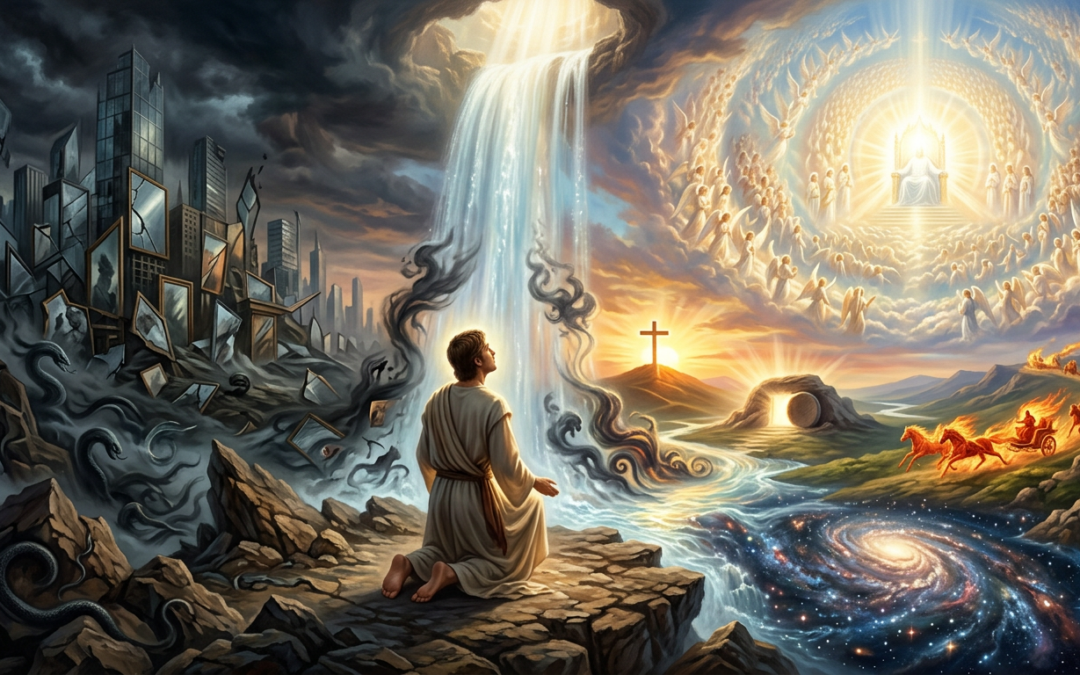
Every person lives in two worlds at once. One is the world we can see and touch. The other is the world we picture inside our minds. In that inner world, we replay conversations, imagine the future, fear what might happen, and dream about what could be. Though it feels private and harmless, this hidden world quietly shapes who we become. What we imagine over and over again slowly teaches us what to love.
Imagination is not just for children or artists. It is the engine of desire. Before we act, we picture. Before we choose, we imagine what the choice will give us. Scripture shows this pattern clearly. In the Garden of Eden, the serpent did not begin by forcing Eve to act. He reshaped her picture of reality. He suggested that God was holding something back and that life would be fuller without Him. The fruit became “desirable” because her imagination had been redirected. Sin began with a distorted vision.
This is why the Bible warns that people “became vain in their imaginations” (Romans 1:21). When imagination drifts from truth, love drifts with it. We begin to desire things that cannot satisfy us. We chase images of success, freedom, or happiness that promise life but deliver emptiness. The problem is not that we imagine too much. The problem is that we imagine without asking whether what we picture is true.
Yet imagination itself is not the enemy. It is a gift from God. The same Bible that warns about vain imagination also opens windows into a world far greater than anything we could invent. Prophets see the Lord high and lifted up. Servants of God glimpse armies of angels on the hills. John sees a throne surrounded by light and living creatures crying, “Holy, Holy, Holy.” These are not fairy tales meant to distract us from reality. They are revelations of reality. Scripture trains us to see what is invisible but real.
Hebrews tells us that faith is “the substance of things hoped for, the evidence of things not seen” (Hebrews 11:1). Faith does not shut down imagination. It cleans it. It teaches us to picture the world as it truly is. When Elisha prayed for his servant’s eyes to be opened, the young man suddenly saw that the hills were filled with horses and chariots of fire (2 Kings 6:17). The danger had not vanished, but the greater reality had been revealed. His imagination was no longer ruled by fear because it had been anchored to truth.
To baptize the imagination means to bring it under the lordship of Christ. Baptism is not destruction; it is cleansing and dedication. When we baptize our imagination, we do not crush creativity. We surrender it. We allow Scripture to correct our false pictures and enlarge our small hopes. Paul writes that we are to bring every thought into obedience to Christ (2 Corinthians 10:5). This includes the pictures we rehearse in the quiet of our minds.
Some people feel embarrassed by Scripture because its images seem too bright, too dramatic, or too strange for modern life. Thrones in heaven, angels with wings, a returning King riding on clouds—these can feel distant from our daily routines. But that embarrassment fades when we realize that the Bible is not shrinking reality; it is expanding it. Our culture often presents a flat, narrow world, closed off from glory. Scripture opens the ceiling and shows us that history is held within an infinite story. When imagination is grounded in truth, trust begins to grow. We are no longer pretending that heaven is real. We are learning to see that it is.
God’s own imagination is not small. He spoke galaxies into being and formed human hearts capable of love. His creativity is not wild or reckless; it is holy and life-giving. Because God is infinite, imagination anchored in Him does not shrink. It grows clearer and stronger. When we imagine apart from Him, our thoughts circle around fear, pride, or self-invention. That path always narrows. It leads toward control, comparison, and despair. But when imagination rests on the character of God, it opens into worship. It stretches toward mercy, courage, sacrifice, and hope. It grows not darker, but brighter.
Stories play a powerful role in this shaping. The tales we love quietly train our expectations. They teach us what kind of hero we admire and what kind of ending we hope for. True Fantasy does not pull us away from the real world; it awakens longing for the truest one. It stirs a hunger for justice, a desire for a rightful King, and a hope that evil will not have the last word. These longings are not childish. They echo the Gospel. In Christ, the greater Hero enters history, faces the dragon of sin and death, and rises again. What feels like myth becomes solid fact. The deepest story becomes the truest love.
As our imagination is baptized, we begin to desire differently. We picture forgiveness before revenge. We see humility as strength. We imagine eternity breaking into ordinary days. Setting our minds “on things above” (Colossians 3:2) does not mean ignoring the earth. It means interpreting the earth through the lens of heaven. The more clearly we see God’s glory, the less appealing destruction becomes. Sin promises excitement, but it always shrinks the soul. God promises life, and His glory keeps unfolding without end.
This journey is not about becoming more imaginative for its own sake. It is about learning to love what is real. When imagination is anchored to truth, it no longer drifts toward illusions. It becomes a window into the heart of God. The One who imagined the stars into existence invites us to see the world through His light. As we do, embarrassment fades, trust grows, and love deepens. We discover that reality is more beautiful than anything we could invent.
True Fantasy Reflection
Take time to notice what fills your inner world. Before you let your imagination run ahead, pause and ask, “Is this true?” Let truth speak first. Open Scripture and allow its images to shape what you see. Picture Christ on the cross, not as a symbol but as the turning point of history. Picture the empty tomb as the beginning of a new creation. Picture the throne of God as the steady center behind every shaking nation. When truth leads, imagination becomes anchored to the Rock. From that secure place, it can grow without limit. Ask truth before imagination, and you will find that your imagination does not shrink. It expands into glory, learning to desire what is eternal and to love what will never fade.