
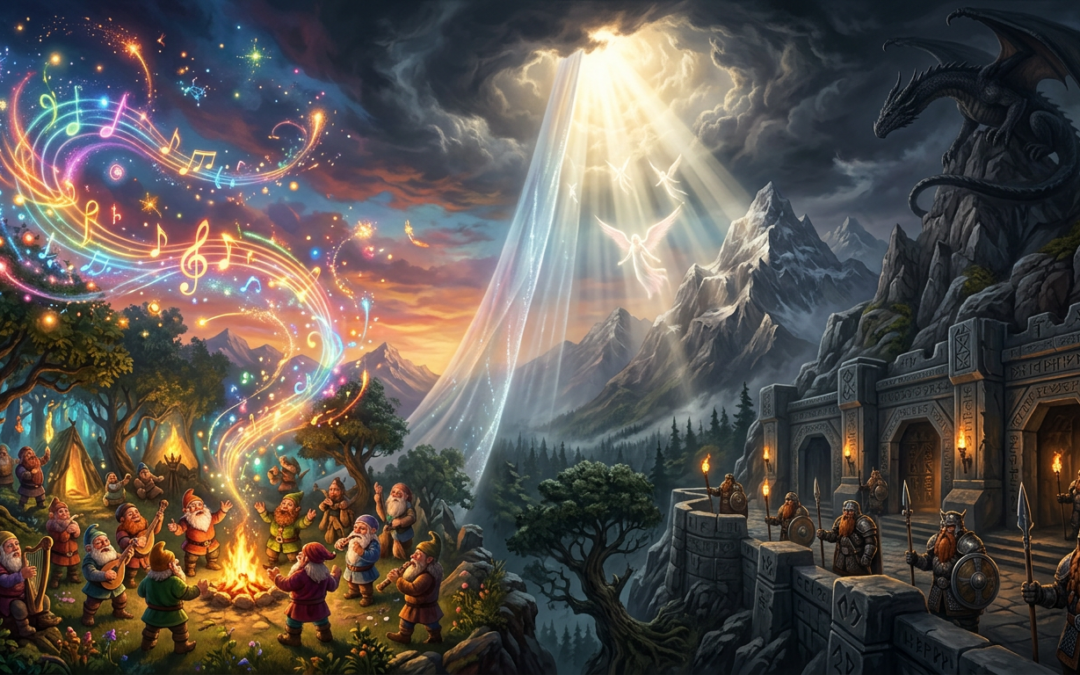
J.R.R. Tolkien went to see Snow White and the Seven Dwarfs.
He did not like it.
That surprises many people. After all, Tolkien loved fairy stories. He filled his own books with dwarves, dragons, dark forests, and ancient songs. Walt Disney did the same, though in a different way. Both men shaped the imagination of the modern world. Both used magic in their tales. Both told stories that have lasted for generations.
So why would Tolkien dislike Disney’s version of a fairy tale?
The answer is not small. It reaches down into the meaning of fantasy itself.
Years after Snow White, Disney released a film called Fantasia. The name is beautiful and musical, and it comes from the same family of words as “fantasy.” That word traces back to a Greek root, phantazein, which means “to make visible” or “to present to the mind.” At its heart, fantasy is about seeing. It is about bringing something before the eyes of the soul.
In Fantasia, Disney did something bold and dazzling. He took music and turned it into color and motion. Notes became dancing shapes. Sound became story. It was imagination poured out onto the screen. For many, it felt like stepping into a dream.
There is nothing wrong with beauty or imagination. They are gifts. Yet Tolkien sensed that something deeper was at stake. He believed fairy stories were not simply decorations for the mind. They were not toys. They were not soft bedtime tales meant only to charm children. To him, they carried weight. They were echoes of an older music, hints of a truer world.
Disney’s dwarfs in Snow White were cheerful and comical. They sang as they worked. They stumbled and joked. They were lovable. Tolkien’s dwarves, by contrast, were ancient and grave. They carried long memories and deep wounds. They belonged to a world shaped by sacrifice and sorrow as well as joy. Even the spelling mattered to him. He changed “dwarfs” to “dwarves,” as if to guard them from becoming caricatures.
Why such concern over something so small?
Because Tolkien believed fantasy was not escape from reality. It was a way of seeing reality more clearly.
Here is where the battle begins.
There is a kind of fantasy that invents wonders simply to entertain. It dazzles the eyes and stirs the feelings. It offers a pleasant journey away from the ordinary world. This is fantasy as spectacle. It begins with imagination and builds outward.
But there is another kind of fantasy, closer to the meaning of phantazein. This kind does not begin by inventing a new world. It begins by unveiling the one we are already in. It makes visible what is already real but often unseen. It does not shrink from darkness or mystery. Instead, it reveals that the world is deeper than it appears.
Disney’s Fantasia turns music into images. It makes the invisible patterns of sound visible in color and movement. That is a creative and beautiful act. Yet it still flows from the human imagination outward. It is art expressing itself.
Phantazein, in its older and richer sense, moves in the other direction. It is not the mind projecting wonder onto the world. It is reality disclosing its wonder to the mind. It is revelation.
Tolkien believed the greatest fairy story of all was not found in Middle-earth but in the Gospels. He once helped C.S. Lewis see that Christianity is the “true myth,” the story that carries all the beauty and power of legend and yet actually happened. The longing behind every dragon and every enchanted forest finds its answer not in make-believe, but in the Incarnation.
The Invisible became visible. The Author stepped into His own story.
That is not fantasy as fabrication. It is fantasy as revelation. It is phantazein in flesh and blood.
Now consider what happens if we treat Scripture the way modern culture often treats fairy tales. We soften it. We tidy it up. We turn miracles into metaphors. We make angels into symbols and the resurrection into inspiration. We keep the beauty but lose the weight. We keep the feeling but lose the fact.
In doing so, we trade phantazein for Fantasia.
We are left with spectacle instead of truth, charm instead of glory.
Tolkien feared that when ancient stories are thinned out and polished for easy consumption, we lose our taste for what they were meant to awaken. If dwarves become merely comic relief, if dragons become merely exciting, if magic becomes merely cute, then we may forget that these images once pointed beyond themselves. They stirred longing for justice, for courage, for sacrifice, for a kingdom that cannot be shaken.
True Fantasy does not ask us to escape the world. It asks us to see it. It tells us that the talking serpent, the parted sea, and the empty tomb are not embarrassing leftovers from a childish age. They are signs that reality is larger than matter and richer than mechanism. They declare that the visible world rests upon an invisible foundation.
In that light, the disagreement between Tolkien and Disney becomes more than a matter of taste. It becomes a question about reality. Is fantasy something we create to decorate life, or is it a window through which life is revealed?
Disney gave the world Fantasia, and it is filled with color and motion and daring imagination. Tolkien guarded something quieter but heavier. He guarded the belief that the deepest stories are not ours to tame. They come to us as gifts. They point beyond us. They whisper of a truth that stands behind the curtain of the visible.
The battle for fantasy is still being fought. Our age loves spectacle. We stream superheroes and sorcerers. We fill our shelves with magic and monsters. Yet when Scripture speaks of an unseen God who acts in history, we hesitate. We can’t comprehend grace, which is a power far superior to any superhero. We are comfortable with dragons. We are uneasy with angels.
Perhaps that is because dragons can remain safely imaginary (at least for now). Angels cannot.
True Fantasy calls us to recover the older meaning of phantazein. It invites us to believe that the world is not a closed box of matter and motion. It suggests that the reason we love enchanted forests and heroic quests is that we were made for a story that is both more terrible and more beautiful than fiction.
Tolkien did not hate imagination. He loved it too much to see it diminished. He knew that when fantasy is cut loose from truth, it becomes thin. But when fantasy is anchored in what is real, it becomes a doorway. It becomes a lamp in a dark wood. It becomes a path that leads home.
The question is not whether we will have fantasy. The question is which kind we will choose.
Fantasia, born from the imagination.
Or phantazein, the making visible of what is eternally real.
True Fantasy chooses the latter. And once the Invisible has been made visible to the heart, even the simplest story begins to shine with a deeper light.