
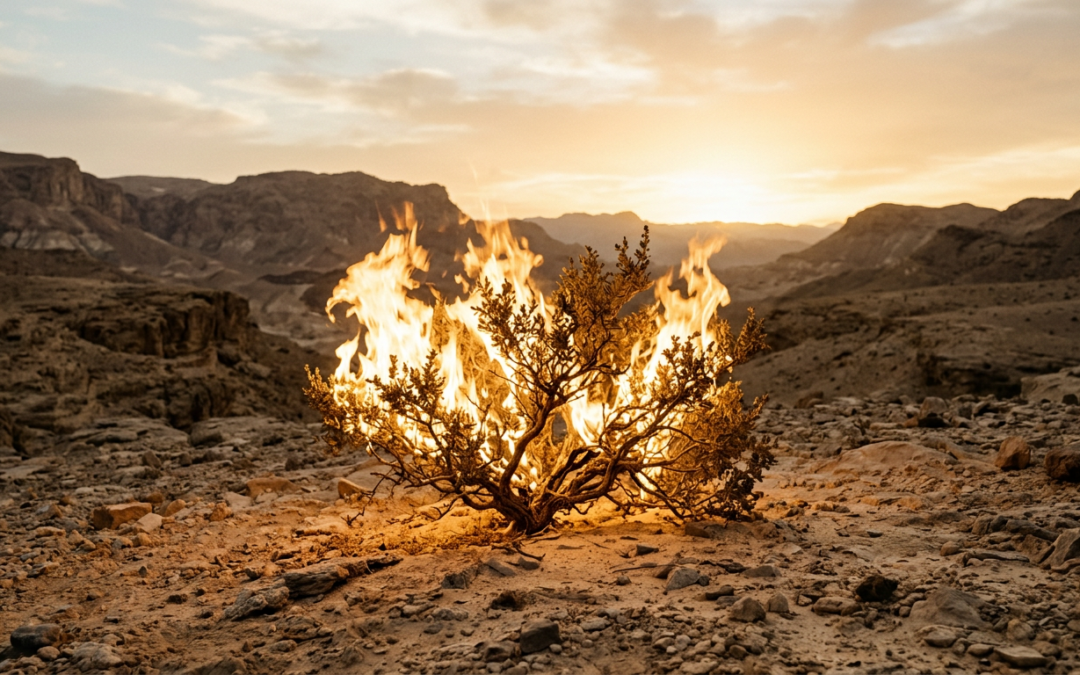
Moses was not searching for wonder when he saw the burning bush. He was tending sheep, walking familiar ground, living a life that felt small compared to the palace he once knew. The desert was dry and ordinary. The work was repetitive. Nothing in that field suggested that history was about to turn.
Then he saw fire.
At first glance, it may have looked like any other flame. In the wilderness, heat and dryness make burning common. But this fire did not behave like other fires. The bush burned, yet it was not consumed. The branches did not blacken. The leaves did not curl into ash. Something in Moses knew this was not natural. This was not matter acting on its own. This was an interruption.
From a material standpoint, the scene makes no sense. Fire consumes fuel. It feeds on what it burns. Yet here was flame without destruction, heat without ruin. The laws Moses knew were bending before his eyes. The only explanation was not found within the bush, but beyond it. The supernatural God had stepped into the natural world.
This is how divine incursion begins. Not always with thunder, not always with spectacle, but with a sign that the ordinary is no longer closed in on itself. God does not need grand stages. He can take a shepherd’s field and turn it into holy ground.
When Moses turned aside to look, God spoke his name. That is when the moment deepened. “Take off your sandals,” the Lord said, “for the place where you are standing is holy ground.” The sand had not changed. The rocks were the same. The difference was presence. Holiness is not an abstract idea floating in the sky. It is the nearness of God.
Fire in Scripture often reveals glory. It warms, but it also warns. It gives light, but it also judges. The burning bush shows both mercy and majesty. The flame does not consume the bush, yet it commands reverence from the man who stands before it. Moses hides his face because he knows he is standing before the living God.